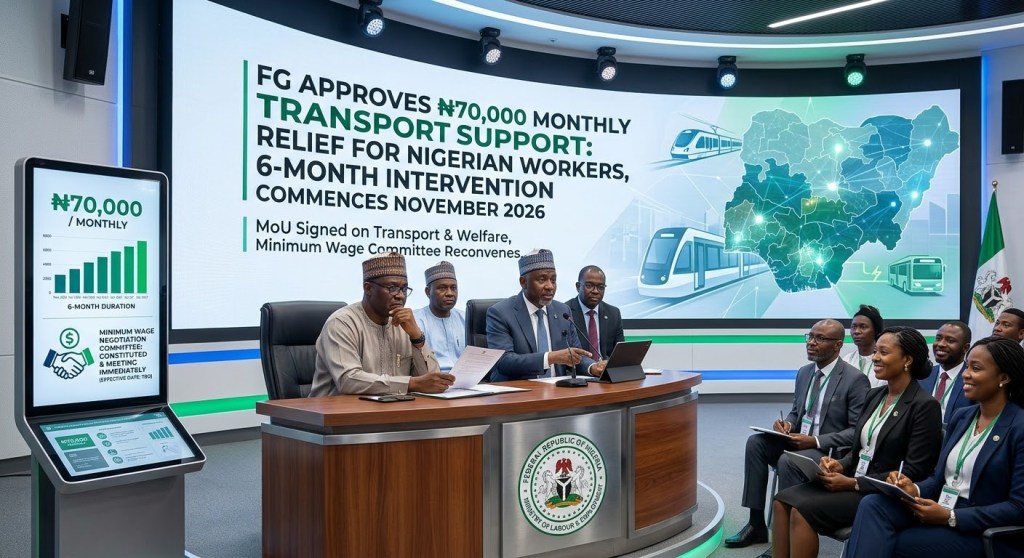
In a significant move to cushion the ongoing economic squeeze on public servants, the Federal Government has approved a ₦70,000 monthly transport intervention fund for all levels of public service workers.
The six-month relief package is scheduled to kick off in November 2026, marking a major takeaway from high-stakes conciliation talks between government representatives and the Nigeria Labour Congress (NLC) in Abuja.
However, while the cash cushion offers immediate financial respite, the long-standing debate over the implementation date of the national minimum wage remains unresolved, leaving key questions hanging in the air for organised labour.
The Breakdown: What Was Agreed?
The pact was formalized in a signed Memorandum of Understanding (MoU) following intense deliberations mediated by the Federal Ministry of Labour and Employment on Tuesday, October 27, 2026.
According to the official resolutions signed by top government officials—including Minister of Labour Dr. Muhammad Maigari Dingyadi and NLC President Joe Ajaero—the key outcomes include:
₦70,000 Transport Support: A flat monthly payout of ₦70,000 across all cadre levels in the public service, running for six months starting November 2026.
Peculiar Allowance Arrears: Payment of outstanding peculiar allowances, backdated to May 1, 2026, will be disbursed in three equal monthly installments starting in November.
Broad Welfare Reforms: Framework agreements touching on tax relief, hazard allowances for agricultural officers, health workers’ remuneration, and worker welfare.
“That transport intervention of Seventy Thousand Naira (₦70,000) commencing from November 2026 would be paid across all levels for a period of six months.”
— Official Resolution Memorandum
While the headline ₦70,000 relief figure has generated relief among civil servants, critical administrative details remain sketchy.
The official MoU does not specify exact monthly payout dates or detail the technical framework for how disbursements will be rolled out across the various ministries, departments, and agencies (MDAs).
With transport fares and essential commodities remaining elevated following the removal of the petrol subsidy in May 2023, workers will be watching closely to see how quickly the promises transition into bank alerts.
Despite progress on transport and back-pay allowances, the elephant in the room remains the National Minimum Wage implementation timeline.
Although both parties agreed to immediately constitute the Minimum Wage Negotiation Committee to resume formal talks, they failed to reach a consensus on the effective starting date for the new wage structure.
The MoU explicitly noted:
“It was agreed that the Minimum Wage Negotiation Committee would be constituted and commence meeting immediately. It should however be noted that there is a disagreement on the effective date of implementation.”
This stalemate leaves a central demand of organised labour up in the air, meaning that while temporary relief has been secured, full structural wage relief remains a work in progress.
What Comes Next?
The coming weeks will prove critical as the Minimum Wage Negotiation Committee convenes to bridge the gap between government timelines and labor demands.
For the millions of public sector workers across Nigeria, the November rollout of the ₦70,000 monthly subsidy will serve as a welcome—if temporary—breathing space as broader labor negotiations continue behind closed doors.


Leave a Reply